
Services / Brine Buster Wash
BRINE BUSTER® UNDERBODY WASH
Remove Salt. Neutralize Brine. Prepare for Maximum Protection.
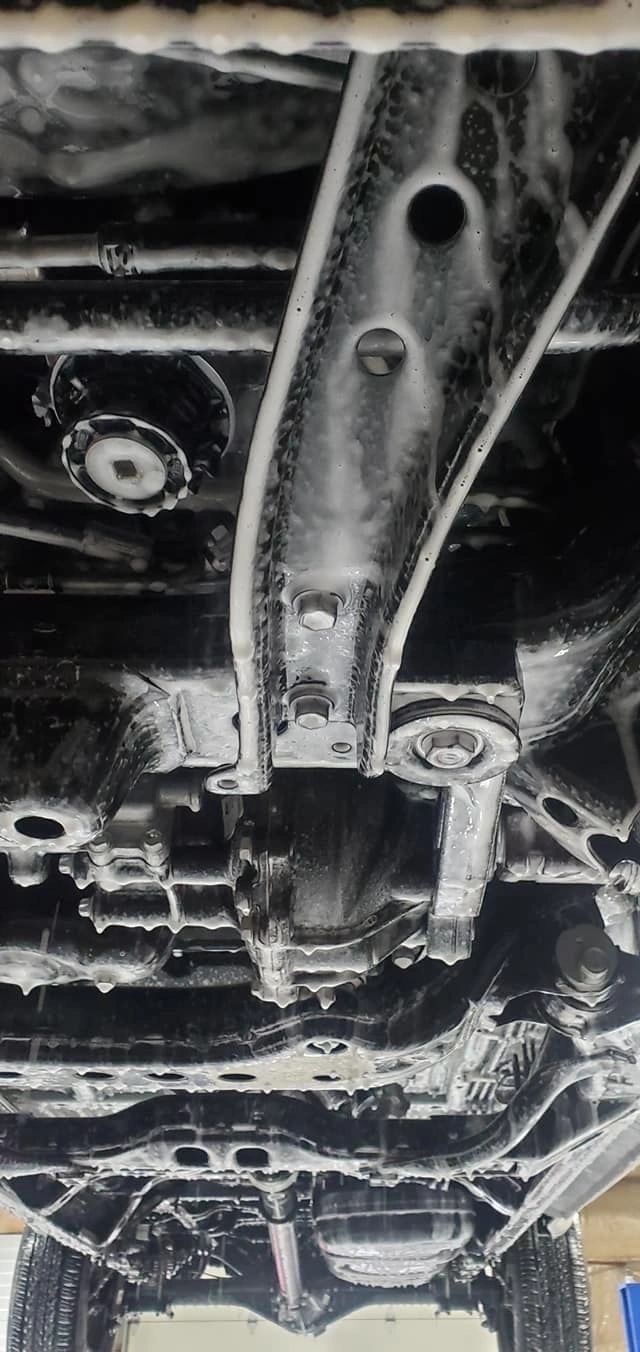
THE ULTIMATE FIRST STEP
The Brine Buster® Underbody Wash is the ultimate first step in protecting your vehicle from corrosion. Designed specifically for modern road chemicals, this service removes and neutralizes harmful calcium chloride, magnesium chloride, and other deicing contaminants that continue attacking your vehicle long after winter has ended.
Unlike a traditional car wash, our Brine Buster process thoroughly cleans the underbody while flushing dirt, salt, and trapped debris from inside boxed frame sections, crossmembers, rocker panels, and other hard-to-reach cavities where corrosion often begins.
For the best possible results, we highly recommend this service before applying Platinum Rust Protection. Starting with a clean, contaminant-free surface allows the rust prevention coating to penetrate more effectively, bond properly, and provide maximum long-term protection.
OUR BRINE BUSTER PROCESS
- Complete underbody wash using Brine Buster® salt and brine remover
- Neutralizes and removes calcium chloride, magnesium chloride, and road salt residue
- Internal chassis flush to clear trapped dirt, sand, and contaminants from boxed frame rails and crossmembers
- Cleans difficult-to-reach areas where corrosive road chemicals accumulate
- Prepares your vehicle for Platinum Rust Protection applications
WHY CHOOSE A BRINE BUSTER WASH?
- Removes contaminants that ordinary pressure washing leaves behind
- Helps eliminate corrosive road brine before it can continue damaging your vehicle
- Improves the effectiveness and longevity of rust prevention coatings
- Ideal before annual Platinum Rust Protection applications
Rock salt dries out.
Magnesium chloride keeps working.
The Chemistry
MAGNESIUM CHLORIDE VS ROCK SALT: WHY MODERN ROAD BRINE IS HARDER ON VEHICLES
Winter road treatment has changed dramatically over the past 20 years. While rock salt (sodium chloride) was once the most common road de-icing chemical, many highway departments now use liquid magnesium chloride and calcium chloride brines.
These modern de-icing chemicals are designed to work faster, last longer, and remain active in colder temperatures. Unfortunately, they also create a much more aggressive corrosion environment for vehicles.
WHAT IS ROCK SALT?
Rock salt is simply sodium chloride crystals. For decades it has been used by municipalities to melt snow and ice on roads. It works by lowering the freezing point of water — when it mixes with snow or ice it forms a liquid salt solution called brine, which breaks the bond between ice and pavement.
- Usually applied as solid crystals
- Works best between 20°F and 32°F
- Requires moisture to activate
- Easily washes off vehicles with water
Because rock salt must dissolve to become active, it typically does not cling strongly to vehicle surfaces. For many years, a simple vehicle wash was enough to remove most salt residue.
WHAT IS MAGNESIUM CHLORIDE?
Magnesium chloride is a highly hygroscopic chemical, meaning it naturally attracts moisture from the air. This property allows it to remain active at lower temperatures and continue working long after application. Because of these advantages, many transportation departments now use liquid magnesium chloride brines to pre-treat roads before storms.
Why road crews use it
- Works in colder temperatures
- Activates faster than rock salt
- Sticks to road surfaces
- Prevents ice bonding before storms
For winter road safety, these properties are beneficial. For vehicles, however, they create a new problem.
WHY MAGNESIUM CHLORIDE CAUSES MORE VEHICLE CORROSION
Unlike traditional rock salt, magnesium chloride actively attracts water. Even when the road appears dry, magnesium chloride residue continues pulling moisture from the air. Your vehicle's underbody can stay damp for long periods of time — perfect conditions for corrosion.
What happens on your vehicle
- 1.Road brine sprays onto the underbody while driving
- 2.Magnesium chloride sticks to metal components
- 3.The chemical attracts moisture from the air
- 4.Metal surfaces remain wet for extended periods
- 5.Rust begins forming
WHY WATER ALONE DOESN'T REMOVE ROAD BRINE
Many vehicle washes rely mostly on water and detergents. While this may remove dirt and loose salt, it often does not fully break the chemical bond created by magnesium chloride brine. Magnesium chloride is designed specifically to adhere to surfaces, which is why it works so well for road treatment.
That same property makes it harder to remove from:
- Vehicle frames
- Suspension components
- Brake lines
- Subframes
- Body seams
Without the right chemistry, residue can remain even after rinsing.
HOW TO REMOVE MAGNESIUM CHLORIDE FROM VEHICLES
To properly remove road brine contamination, the chloride residue must be chemically lifted and neutralized before rinsing. That is exactly what Brine Buster™ was engineered to do. It is not simply a detergent or a water-based wash — it is formulated to:
- Attaches to chloride contamination
- Breaks the bond between salt and metal
- Lifts the residue from the surface
- Rinses completely away
This process removes the corrosive material that continues attracting moisture to metal components.
THE BEST PROTECTION STRATEGY FOR WINTER VEHICLES
Removing road brine is the first step in protecting a vehicle from corrosion. Once the surface is clean, applying a protective coating helps prevent future rust from forming. The most effective approach is a two-step system:
Step 1
REMOVE THE CHLORIDES
Use Brine Buster to break down and rinse away magnesium chloride and road salt contamination.
Step 2
APPLY RUST PROTECTION
Apply Platinum Rust Protection, an oil-based coating that shields metal surfaces from moisture and oxygen.
Together they create one of the most effective corrosion-prevention systems available for vehicles exposed to winter road chemicals.
WHY BRINE BUSTER WAS DEVELOPED
Modern road de-icing chemicals have changed. Magnesium chloride brine is far more persistent than traditional rock salt, and many salt removal products were originally designed for basic sodium chloride residue — not modern liquid brines. Brine Buster was developed specifically to combat:
- Magnesium chloride road brine
- Calcium chloride brine
- Pre-treated road salt
- Sticky de-icing residues
It is engineered for the chemicals actually being used on today's roads.
Common Questions
BRINE BUSTER FREQUENTLY ASKED QUESTIONS
Give Protection A Clean Foundation
SCHEDULE YOUR BRINE BUSTER WASH
Prepare your vehicle for the highest level of long-term corrosion protection. Pair Brine Buster with Platinum Rust Protection for maximum results.